
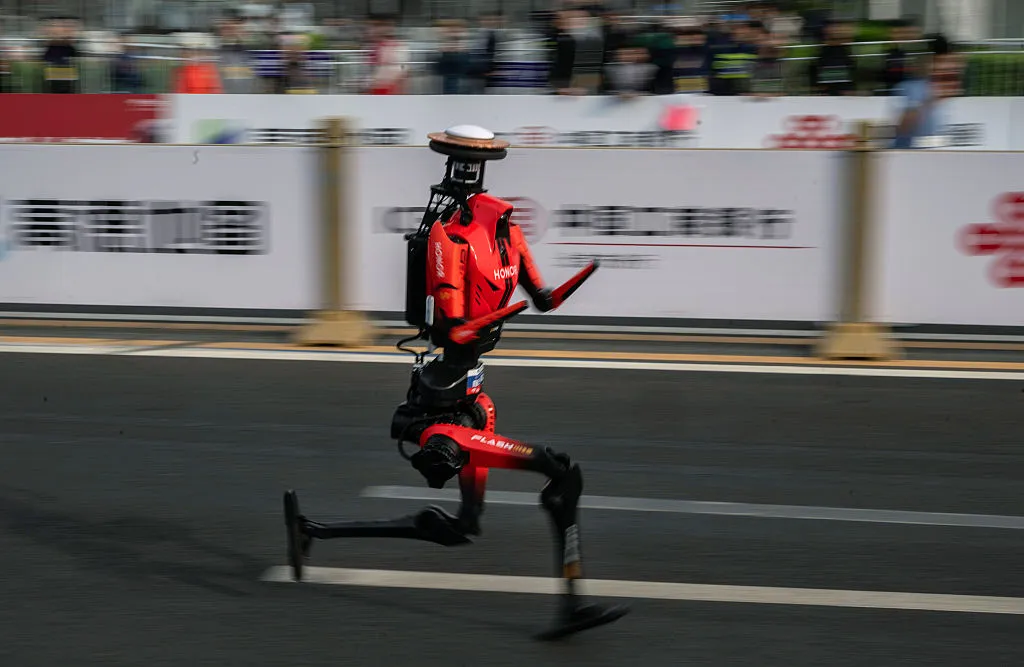
The gap between human athleticism and robotic capability just closed—and then some. At a recent humanoid robot half-marathon in Beijing, a machine completed the race in a staggering 50 minutes and 26 seconds. This time comfortably eclipses the standing human world record of 57 minutes, currently held by Jacob Kiplimo.
A Leap in Mechanical Performance
While comparing a machine to a person might feel like comparing a car to a cheetah, the sheer pace of development is undeniable. Just one year ago, the fastest robot in the same event crossed the finish line in two hours and 40 minutes—a pace most casual human joggers could beat. In only twelve months, the technology has evolved from “unimpressive” to “record-shattering.”
The winning autonomous unit was developed by the Chinese consumer electronics giant Honor. Although another Honor-built robot actually clocked a faster raw time of 48 minutes and 19 seconds, it was operated via remote control. The 50:26 finisher took the top prize due to a weighted scoring system that prioritized autonomous navigation.
Autonomy vs. Remote Control
According to data from Beijing’s E-Town tech hub, the competition saw a mix of piloting methods:
- 40% of the field competed autonomously.
- 60% were controlled remotely by human operators.
Despite the record-breaking speeds at the front of the pack, the event served as a reminder that humanoid robotics is still a work in progress. The race wasn’t without its mechanical casualties; some participants tumbled right at the starting line, while others struggled with basic navigation, including one robot that collided with a track barrier.
As companies like Honor continue to push the boundaries of bipedal movement, these events are transitioning from experimental novelties into genuine displays of high-speed engineering.