
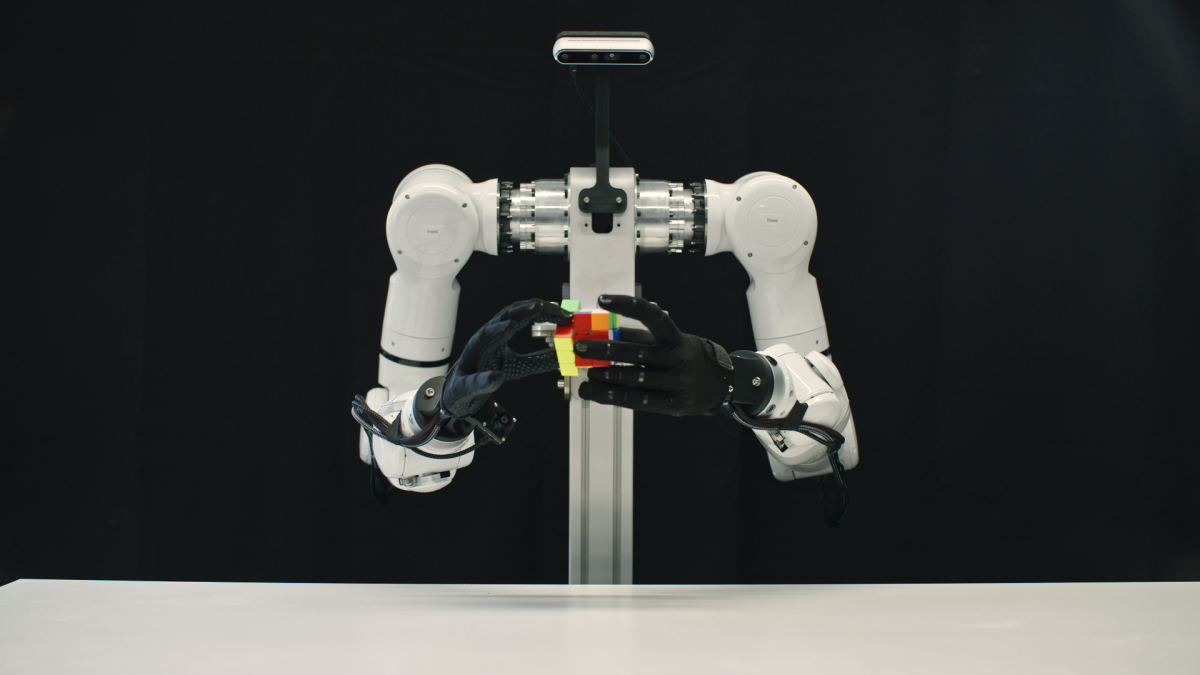
Genesis AI, the robotics powerhouse that emerged from stealth with a massive $105 million seed round, is shifting gears. While the company initially focused on foundational AI, it has now embraced a “full-stack” philosophy, unveiling both its latest model, GENE-26.5, and proprietary robotic hardware designed to mimic the human touch.
The Hardware Pivot: Human-Centric Design
CEO Zhou Xian and President Théophile Gervet (a former Mistral AI researcher) realized that software intelligence is only as good as the physical tools it controls. To overcome the “embodiment gap”—the difficulty of translating digital logic into physical movement—Genesis developed robotic hands that mirror the size and shape of human hands.
Unlike the standard two-finger grippers common in the industry, these anthropomorphic hands allow the AI to learn from a much broader range of human data. In a recent demo, the system successfully navigated complex multi-step tasks, including:
- Culinary skills: Cracking eggs and slicing tomatoes.
- Precision work: Performing laboratory tasks and preparing smoothies.
- Dexterity tests: Solving Rubik’s cubes and playing the piano.
A New Strategy for Data Collection
Data remains the primary bottleneck in robotics. To solve this, Genesis created a sensor-loaded glove that acts as a digital twin for its robotic hands. This lightweight, inexpensive device allows human workers—such as lab technicians or manufacturers—to record data while performing their daily routines.
By combining this “human skill library” with egocentric video and massive datasets from internet videos, Genesis is accelerating its model’s training speed. This iterative process is further bolstered by a sophisticated simulation environment, allowing for rapid evaluation before the AI ever touches a physical object.
Scaling for a General-Purpose Future
With $105 million in backing from Khosla Ventures, Eclipse, and high-profile investors like Eric Schmidt and Xavier Niel, Genesis is expanding rapidly. The team of 60 is currently split between California, Paris, and London.
While the current focus is on dexterous hands, Xian confirmed to TechCrunch that a full-body, general-purpose robot is the next milestone on their roadmap. The goal remains clear: building the world’s most capable and versatile robotic system.